The term 'ISO consultant' is used quite loosely in the UAE market, and companies approaching certification for the first occasion are often not certain which services they're actually getting when they employ one. Knowing the specifics of the work helps to set realistic expectations, and also makes it easier to determine if a consultant offers genuine value.Translating the ISO Standard into practical Business Terms
ISO standards have been written in a formal, generalised terms that are designed for use in a range of industries, which means a large part of a consultant's work is to translate these standards into the meaning they have for a specific company's day-today activities. A good consultant spends real time understanding how the business is actually operating before suggesting how its processes currently work with the requirements of the standard.
Participating in the Initial Gap Assessment
The majority of work starts with a gap evaluation, comparing existing methods against the relevant specifications to determine which practices are in use, which requires adjustment, and what's missing entirely. The assessment determines the overall schedule and budget of the project, which is why an in-depth honest gap assessment is important more than an optimistic one which undervalues how much work is involved.
In assisting in the construction or refinement process of management System Documentation
When the weaknesses are uncovered, consultants are usually able to help create or enhance the written policies, procedures as well as records to prove compliance. However, current standards emphasize genuine respect for processes over paperwork volume. Best consultants caution against overly detailed documentation in order to gain a profit choosing a method that the company actually uses over those designed solely to fulfill the auditor's guidelines.
Training Staff for New or modified processes
Implementation doesn't have to be a managerial exercise, since staff at all levels typically have to comprehend what's happening during their normal work hours and the reason for it. Consultants typically conduct classes to aid in the understanding of staff, as a management system that's only in paper but doesn't have real support can easily unravel when the initial pressure for certification has been met.
Conducting Internal Audits to be Prepared for the Actual Thing
Most standards require at minimum one internal audit before the external certification audit is performed, and consultants often either conduct this on their own or train internal staff members to conduct such audits. This internal audit functions as an actual dry run, it reveals issues that need to be addressed while there's time to address them rather than identifying problems for the first time in front of an external auditor.
Helping the Business through the External Audit
While consultants generally can't be there on behalf during any certification process because of the strict requirements regarding independence professional consultants must prepare their clients with a thorough preparation prior to the audit. They are on hand to interpret as well as address any ambiguities that identified by the auditor externally.
What a Consultant Should Not Be Doing
A legitimately functioning consultant should never be the same company that is certifying the certificate, since this could undermine the trustworthiness of the entire system is built on. Any consultant that claims to implement your system of management and certify it all under the same umbrella is a real concern to consider rather than a convenient shortcut.
Helping Interpret Standard Updates and Revisions
ISO standards are continuously revised, and a good consultant is able to keep clients updated on new standards well before they are required, giving the business time to adjust rather than scrambling at the last minute. The advisory role of a consultant often will continue well after the initial certification phase particularly for companies that engage a consultant on lower-cost basis for regular supervision audit support.
How to adapt the approach to business Size
A skilled consultant adjusts their approach in a way that is appropriate to what they're dealing with, be it a five-person startup or a five-hundred-person enterprise, since a management system genuinely proportionate to business scale and complexity is more likely of being maintained more effectively than a system based on an even larger scale of requirements. Beware of a one-size-fits-all template in use regardless of the business's actual size.
Achieving Internal Capability and Not Just Dependency
The best consultants aim to leave a company more self-sufficient than when they started, training internal staff to eventually manage much of the system independent of the company, rather than creating dependent relationships solely for the sake of their own continuous billing. Contacting a potential consultant directly how they approach internal capability creation is a fair method of determining whether they're genuinely focused on long-term client success.
A Realistic Timeline to Engage a Consultant
A lot of businesses underestimate the point at which in the certification journey the consultant should be engaged, and often calling only when the deadline for engagement is set. Engaging a consultant at a time that is sufficient to conduct an honest gap assessment, rather than rushing implementation under time pressure and consistently results in a stronger managed system, which is more sustainable than a compressed, deadline-driven engagement.
Recognizing when you've surpassed the need for a professional
Certain UAE companies, especially the larger ones that employ dedicated compliance or quality personnel can eventually get to a point in which they can conduct ongoing surveillance audits as well as standard changeovers in-house. This means they can engage a consultant only for occasional consultations from specialists. Recognizing this instead of having to provide full consultant support indefinitely, reflects an evolving management system that has been integrated into what the business does.
Understood properly, a good ISO Consultant in the UAE operates less as an agent for paperwork and more of a temporary addition to the management team. He or she will guide a business through a genuine shift in operations, not just producing documents to satisfy the requirements of an external source. Choosing the right consultant, and understanding clearly what their job description should and shouldn't consist of, is what makes the difference between a project for certification that will actually improve the way the business runs, as opposed to one which issues a certificate that doesn't have any lasting change in the operational environment behind it. None of this makes the work of a consultant any less important, but it's important for businesses to engage in a real partnership instead of outsourcing the entire certification burden on to another. A change in mindset alone can help to produce a considerably more reliable and long-lasting certification. The involvement becomes a true purchase rather than just a expense to meet compliance requirements. This is a distinction worthy of paying attention to throughout. View the top ISO 27001 Certification for more tips.
ISO 9001 Explained: Quality Management for UAE Businesses
ISO 9001 remains the most widely-respected management system across the world, in good reason. It's built on a sensible idea that consistently quality results from consistently properly-managed processes, not just good intentions by themselves. For UAE companies considering certification, understanding what the standard actually requires can help simplify an idea that can seem more complex than it actually is.What ISO 9001 Is Actually built around
It is at the core of it all. ISO 9001 asks a business to define its main processes and understand how they interact and how they interact, evaluate whether they're working, and improve them consistently as time passes. Rather than prescribing exactly how a business should operate It provides a system for ensuring that every approach one takes should be logical, documented where necessary, and genuinely followed.
The reason UAE Businesses Want to Get It?
Beyond its reputational benefit of ISO certification, many UAE businesses seek ISO 9001 because government and private sector tenders are increasingly mentioning it as prerequisite for prequalification. Beyond ticking that box when they implement it, companies that do it in a proper manner often experience real operational benefits. These include fewer repetitions of mistakes, greater accountability as well as a more systematic approach to handling customer complaints.
The role of top Management
One area the standard is particularly clear about is leadership involvement rather than quality management being handed over entirely to a single compliance official who is unaffected from actual decisions. Auditors look specifically for evidence of senior leadership that understands and actively support the quality management process, rather than just approving on it.
Risk-based thinking is the core of the Modern Standard
The current edition of ISO 9001 places considerable emphasis in identifying opportunities and risks applicable to a specific business setting, rather that applying the standard checklist regardless of the specifics. This means that a UAE construction firm and an UAE software company, despite being each one is certified according to the exact standard in the end, will have an entirely different quality management system in line with their very different risk profiles.
Customer Focus Runs Throughout the Standard
ISO 9001 repeatedly returns to the idea that quality involves meeting the customer's requirements as well as expectations. It's not merely internal efficiency metrics. Companies that follow the standard will be expected to have genuine mechanisms to understand what their customers require and whether or not they're satisfied, instead of assuming internal quality inspections alone will provide the entire picture.
The Certification Process Itself
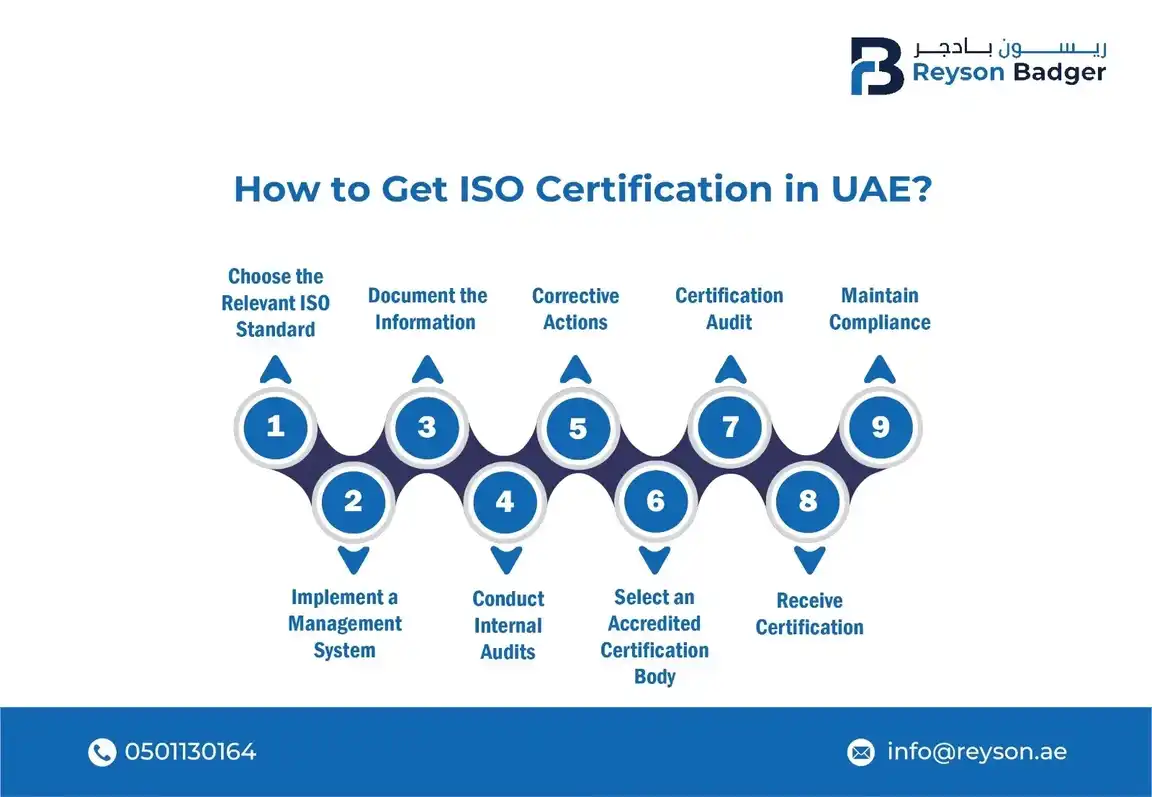
After implementing the appropriate processes as well as documentation, certification includes an external audit that is conducted in two stages. First, it is a review of the documentation and readiness before assessing whether the system is actually operating as it is described. Certification is followed by regular inspections of surveillance and a thorough reconcertification audit around every three years to confirm continued conformance.
Common Misconceptions worth clearing
It is widely believed that ISO 9001 requires enormous volumes of paperwork, when the most recent version has cut down on the mandatory documentation substantially compared to older versions, and is focused on demonstrating the effectiveness of process control. Another misconception is that ISO 9001 certification assures the quality of products directly, but it actually proves that businesses have a consistent way of managing quality and is a fundamentally different but nonetheless a valuable aspect.
How Differently It is Applied Across Industries
A construction company which has implemented ISO 9001 will focus heavily on the handover process and subcontractor management. On the other hand, a professional services firm could concentrate upon client engagement processes as well as knowledge management. Its real-time flexibility across sectors is part of the reason it is still relevant for such a broad spectrum of UAE industries, from manufacturing through to consulting and retail.
The importance of continuous improvement
ISO 9001 doesn't treat quality in a linear way, instead it's an ongoing process of monitoring performance, identifying opportunities to improve, then implementing those changes regularly. Businesses that genuinely embrace this continual improvement mindset, rather than seeing certification as a one-time project, are likely to reap the greatest long-term operating benefits from ISO 9001.
Get Your Team Prepared in the Cultural Shift
Perhaps the most neglected aspect that is often overlooked in ISO 9001 implementation is the real cultural change that is required, switching from informal, individual-dependent methods of working to more systematic, consistent processes that don't solely rely on one individual's memory or judgment. The preparation of staff members for this shift and communicating the advantages, rather than making it appear only as a compliance issue, considerably improves how smoothly Implementation goes.
How do you know that an investment is likely to pay off
Organizations that implement ISO 9001 thoughtfully, rather being viewed as the exercise of completing paperwork to meet an external requirement, generally experience the benefit of investing through fewer repeated errors, improved internal accountability, as well as a genuinely stronger foundation for expansion as the enterprise grows. Benefits are far beyond the certification as a whole.
Where and How ISO 9001 Interacts With Customer complaints specifically
The Standard requires businesses to implement a legitimate, well-organized method for handling customer complaints and feedback. They must treat each complaints as a data point that should feed back into improving the efficiency of the process rather than being ignored and then forgotten. UAE businesses that design an effective feedback loop have it become one of the most beneficial components of the management system in addition to its importance in fulfilling the audit.
For UAE companies looking to determine if ISO 9001 is worth pursuing and pursuing, the real question boils down the question of whether you really need more reliable, more well-managed processes since the certificate itself is actually a formal confirmation of the core operational discipline. For UAE companies who are truly committed to improvement in their processes and not just collecting an accreditation, ISO 9001 offers a established, internationally recognized process for making the change as a process rather than an accident. The process does not require the elimination of the practices that are already working well within an organization, since ISO 9001 is fundamentally about consolidating and establishing good practice instead of replacing it with something entirely unfamiliar. If it is approached this way the certification can be seen as a natural extension of good management, not an external burden on the company. It is, at the end of the day an instrument built on regular use of common sense rather than a complex system. That above all else, is the main reason why it merits genuine consideration. Few other investments can offer such vast, long-lasting operational value. It is definitely worth the time it takes to get right. Check out the best ISO Certification Services for blog recommendations.
